

The Daily Vroom

Hey there, fellow Vroomers!
Guess what's on the agenda for today? We're diving deep into the world of Bring A Trailer. I've rolled up my sleeves and taken a good, long look at what's going on under the hood. I've got a treasure trove of insights and trends to share with you, and trust me, I could've gone on forever – there's just so much to dissect.
Let me break it down for you. I've meticulously examined their sales data from May to July, drawing conclusions from a whopping 7000+ sales! It's been a labor of love, and I've burned the midnight oil on this one. Now, I'll put it out there – this post might be quite a read, and if you happen to spot any glaring mistakes, I apologize in advance.
But hey, let's jump right in!
Oh oh! I’ve just been warned that this post being so long might get clipped by Gmail. If that’s the case you can click ‘Read Online’ in the top right hand corner.

BRING A TRAILER SALES
Unveiling the Powerhouse: Bring a Trailer's Phenomenal Journey in the Car Collecting Universe
Steering through the lanes of online car auctions, today I embark on a deep dive into the enigmatic world of Bring a Trailer. Founded in 2007 by the visionary Randy Nonnenberg, this digital marketplace has become a true behemoth in the automotive industry, a name that echoes louder than the combined revs of its online competitors. Earning a remarkable distinction, this San Francisco-based platform shifted gears under the Hearst Autos umbrella in January 2020, solidifying its place as a trendsetter in the realm of car collecting. From its inception, it has been a driving force, rewriting the rules of car buying and selling, an evolution that has been nothing short of awe-inspiring.
Navigating the Uncertain Terrain: Challenges and Innovations Ahead
While the crescendo of Bring a Trailer's achievements has been undeniably spectacular, the road ahead is not without its challenges. The realm of online car auctions has become a bustling arena, with heavyweight players like Sotheby's joining forces with Motorsport to unveil a fresh auction platform and Pistonheads in the UK venturing into this realm as well. Here in the U.S. Cars & Bids, backed by the formidable Chernin Group, has the ambition to take on Bring a Trailer head-on. The competitive winds are shifting, and as the dust settles, a critical question arises: Can Bring a Trailer maintain its velocity in this altered landscape, or has the once-unstoppable growth engine begun to decelerate?
Beyond the Horizon: Fueling Growth and Innovation
As we peer under the hood, it becomes clear that Bring a Trailer's journey is not only about surging revenues and skyrocketing sales but also about advancing the engine that drives their success. In an era defined by digital acceleration, technological innovation stands as the fuel that propels companies forward. Nonnenberg's aspirations extend beyond merely expanding the listings count. The ambition is to harness the power of technology to refine and expedite the listing process, from submission to the live launch on their platform. The goal of shrinking the average wait time from to just 10 days is a testament to their determination to optimize efficiency, creating a seamless experience for buyers and sellers alike.
Glimpse Under the Hood: Insights from the Past Three Months
Turning our attention to the past three months, the terrain of Bring a Trailer's activity reveals intriguing trends and insights. As the fervor for online car collecting persists, it's crucial to analyze the patterns that have unfolded. What models have seized the spotlight? What price brackets have resonated the most with buyers? By delving into these details, a tapestry of preferences and shifting dynamics emerges.
However, while analyzing the data provides a glimpse into the present, predicting the future requires a nuanced understanding of the broader landscape. The elephant in the room remains the global economic climate. Will the pandemic-driven fervor for collector cars stand firm, or will economic uncertainties and market shifts bring about a reckoning?
Enough of me waffling on, let’s get to some numbers and charts .
A Few Points on Our Data Interpretation:
-
Scope of Analysis: Our focus has been primarily on vehicles. While Bring A Trailer (BaT) offers a diverse range of products, from tires to memorabilia, such non-vehicle items have been excluded from our dataset.
-
Accuracy of Data: While I strive for precision, it's worth noting that my figures might not capture the complete picture down to the last detail. A sale might have been overlooked or a specific item missed, but the overarching trends and insights remain reliable and indicative of the broader market dynamics on BaT.
-
Rounded Figures: For clarity and ease of comprehension, most of my larger average figures have been rounded to the nearest hundred. This approach streamlines the data presentation without compromising the essence of our findings.
-
Volume of Sales: My analysis spans an impressive volume of transactions, with over 7,000 sales taken into consideration!
SALES MAY-JULY

In May 2023, "Bring A Trailer" achieved a robust sales volume of over $120m through a total of just over 2,500 car transactions, leading to an average sale price of $46,900 per car. Notably, a 2019 McLaren Senna stood out, fetching a spectacular $1,286,000.
June ushered in a slight dip with sales amassing $107m from just over 2,200 cars, with each averaging $47,400. Yet, it wasn't without its highlights. The month was marked by the sale of a 1967 Porsche 910, which commanded an impressive $2,500,000.
July, while recording a sales volume of $111m from again just over 2,200 cars, saw a spike in the average transaction, reaching $49,500. The top-tier sale of the month was a classic — the 1961 Maserati 5000 GT Indianapolis Coupe by Allemano, which was sold for an astonishing $1,030,000.

Comprehensive Car Sales Summary for the Last 3 Months
The Big Picture: The automotive landscape over the past quarter has showcased both perennial favorites and emerging contenders. While established models maintained their strong presence, there were a few surprise performers.


Dominant Players: As expected, the Porsche 911 led the pack with over 500 sales, solidifying its evergreen appeal. Hot on its heels were the Chevrolet Corvette and BMW 3 Series, registering 300+ sales, holding their ground in the marketplace.
Pricing Dynamics: Car enthusiasts seemed willing to spend a bit more as months progressed. While the average car prices in May and June hovered around $47K and $47,500 respectively, July saw a slight increase, reaching an average of $49,500. This could hint at a marginal rise in premium model sales or subtle market shifts.
Movers and Shakers: A notable shoutout to the Mercedes-Benz SL-Class with a large growing number of sales. The Ford Mustang also galloped its way with 150+ sales. On the other hand, the Mazda RX-7, while iconic, seemed to have a quieter footprint with 22 sales.
A Few Hiccups: All wasn't smooth sailing. Some models like the innovative Rivian R1T and the classic Pontiac Tempest found the going tough, both clocking just a single sale. Although to be fair to both of them there were only 2 of each listed in total between May-July. I guess BaT is just not the site for either of these to be listed.
A Glimmer of Hope: Every cloud has a silver lining. Despite certain challenges, the evident success of models like the Ford Mustang exemplifies the unpredictable yet exciting nature of the automotive market.
SALES TRENDS

Million Dollar Sales
Total Sales Breakdown by Month:
-
May: 2 sales
-
June: 2 sales
-
July: 1 sale
Cars Sold for a Million or More:
-
1967 Porsche 910 sold in June for $2,500,000.
-
2019 McLaren Senna sold in May for $1,286,000.
-
2019 Ford GT ’68 Heritage Edition sold in June for $1,140,000.
-
1961 Maserati 5000 GT Indianapolis Coupe by Allemano sold in July for $1,030,000.
-
2019 Ford GT Carbon Series sold in May for $1,013,000.
Sales Between $500,000 and $1 Million
Total Sales Breakdown by Month:
-
May: 6 sales
-
June: 5 sales
-
July: 13 sales
There's a noticeable increase in sales in this price bracket in July.
Sales Between $100,000 and $499,999
Total Sales Breakdown by Month:
-
May: 243 sales
-
June: 218 sales
-
July: 230 sales
In the chart below, I’ve highlighted the top 10 selling models in May-July. Are there are any that surprise you?
I didn’t realise that BaT sell so many Land Cruisers (a big favorite of mine)

Taking a Closer Look: Exploring the Best-Selling Models, Preferred Years, and Top Prices
Porsche 911
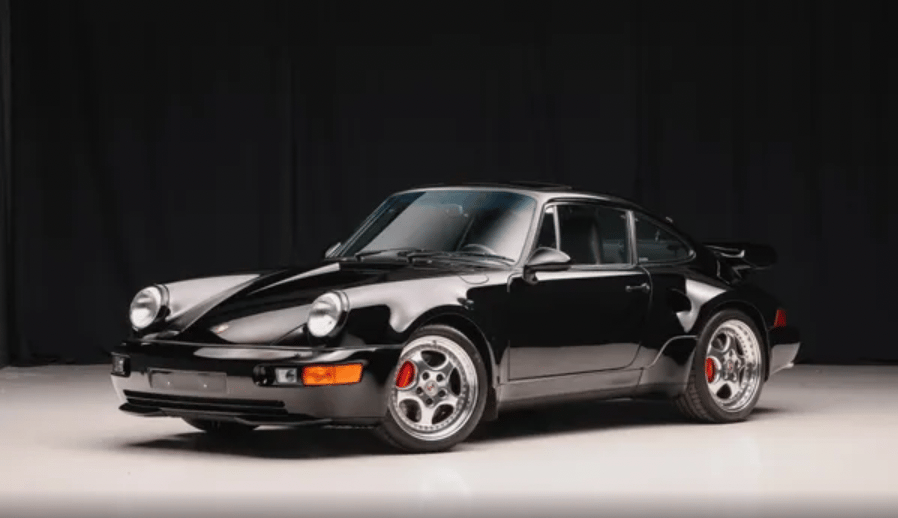

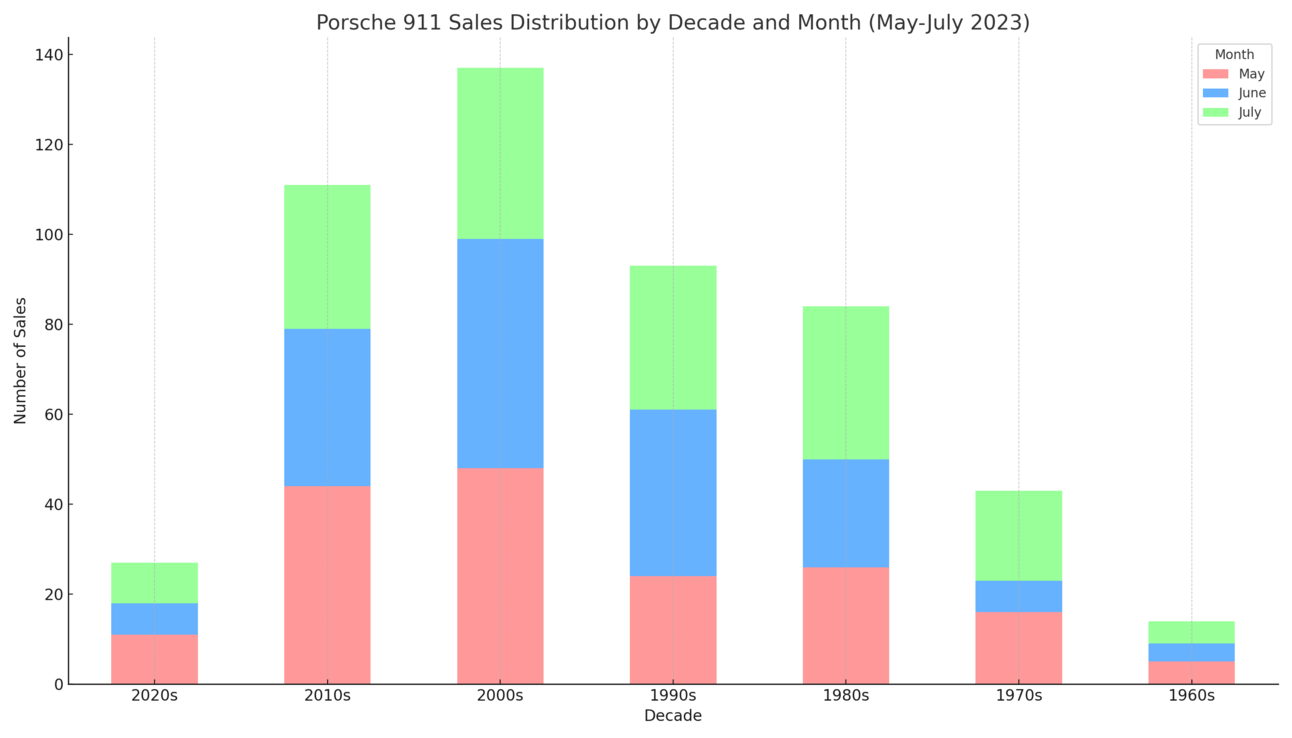
2002 was the winner for the most popular 911 model sold during May-July.
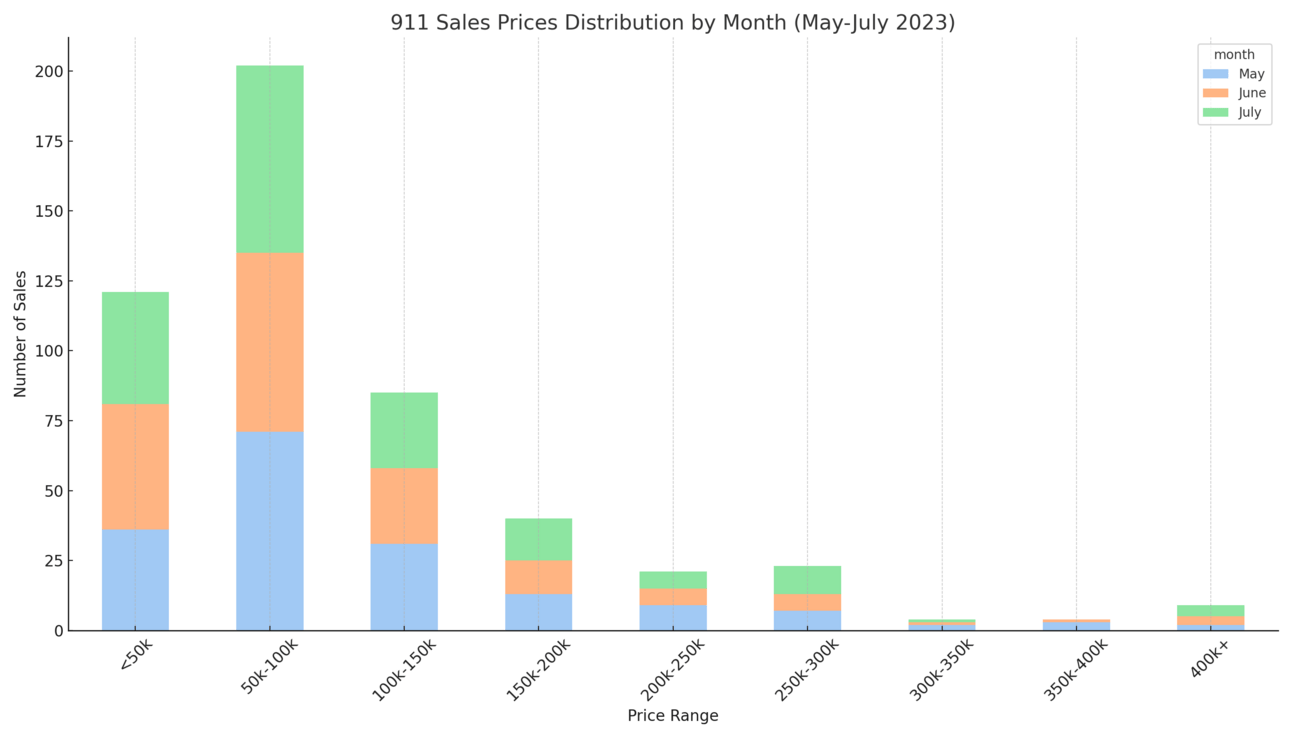
Here's a breakdown of the sales in monetary terms. Examine the chart below to discern any monthly trends or patterns in pricing that you can see. Immediately to me that sales between $50k-$100k are where most of the transactions took place and those amount of sale look pretty equal for the months of May-July.
Chevrolet Corvette

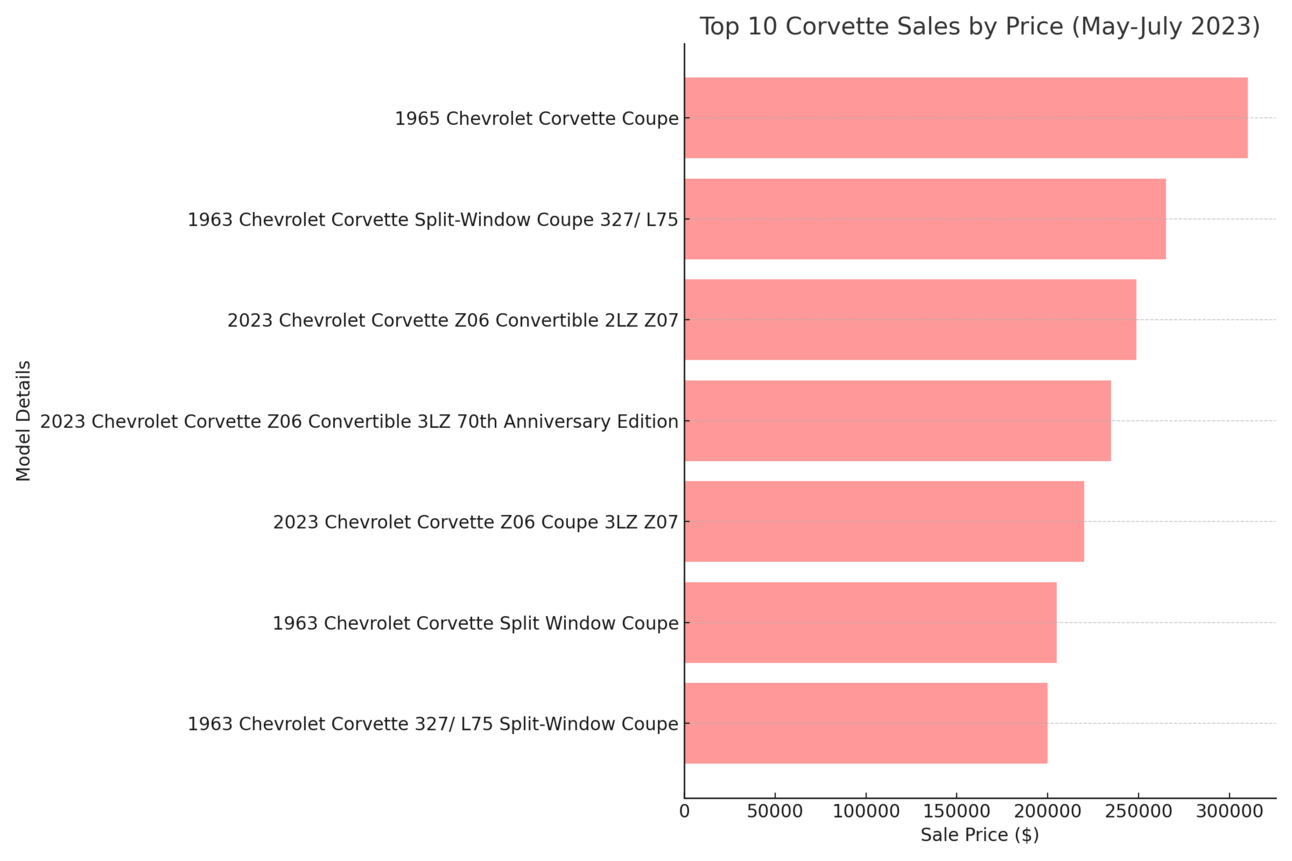
When it comes to sheer numbers, the 1960s take the crown as the best-selling decade. However, in the current landscape, the 2023 Corvette steals the spotlight with the most sales under its belt, boasting an average sale price of $171,900.

Most of the Corvette sales happened between $0-$50K. Equally distributed through all 3 months.

Mercedes-Benz SL-Class


The 2003 SL-Class was the most popular sold in the past 3 months. Fun fact: The 2003 Mercedes-Benz SL-Class is part of the R230 generation. This model year marked a significant design shift for the SL, adopting a more modern and aggressive stance. One of its standout features was the retractable hardtop.

Wow! Very few $100k sales here, but not a surprise if you know the model well.

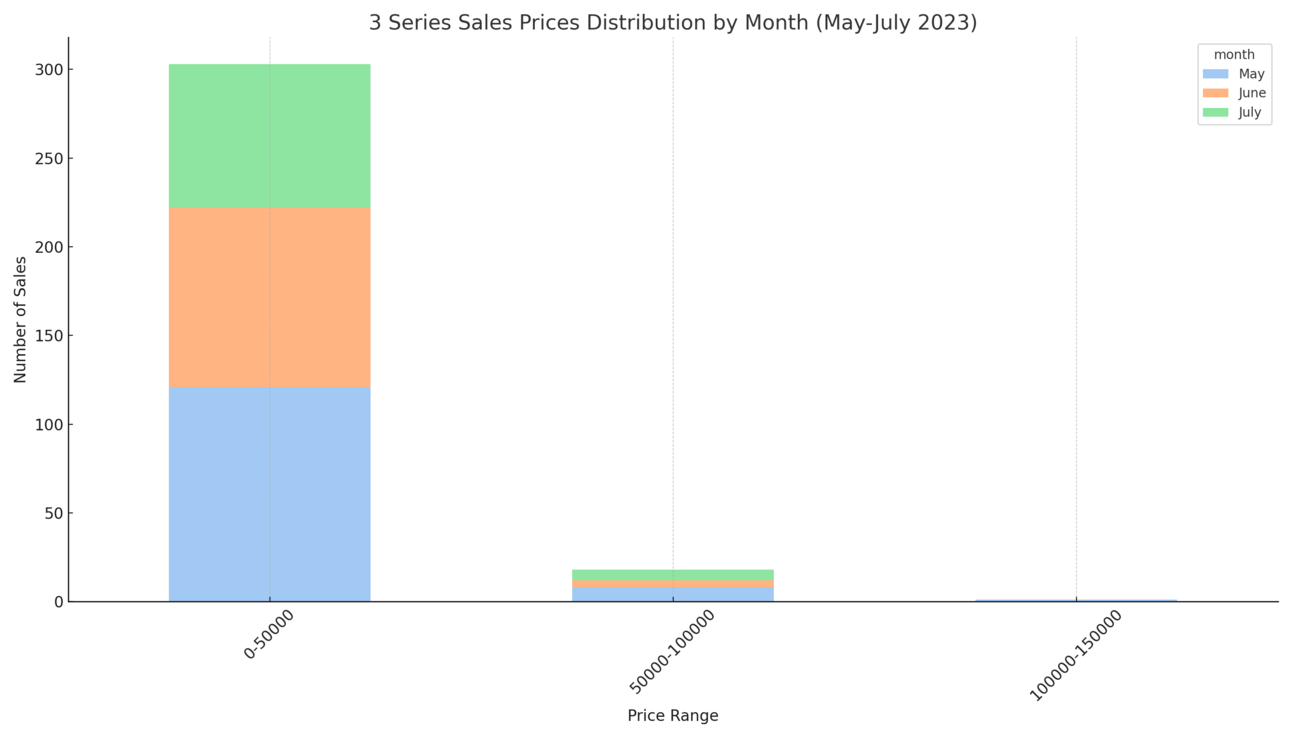
BMW 3-Series


The most popular year of models sold was in fact 2006. Fun fact: The 2006 3 Series incorporated BMW's then-new iDrive system, an improved suspension system, and a range of efficient and powerful engines.

Once again most sales equally occurring up-to $50k.
Ford F-Series


1997 was the most popular F-Series sold. Fun fact: The 1997 Ford F-Series unveiled the tenth generation of this iconic truck lineage. With a more rounded, aerodynamic appearance, this year marked a substantial departure from the design of previous generations.

There are some outliers here with some exceptionally high sales – but most of the F-Series sales happen in the $0-50k range, with the average sale price around $32,000.

Ford Mustang

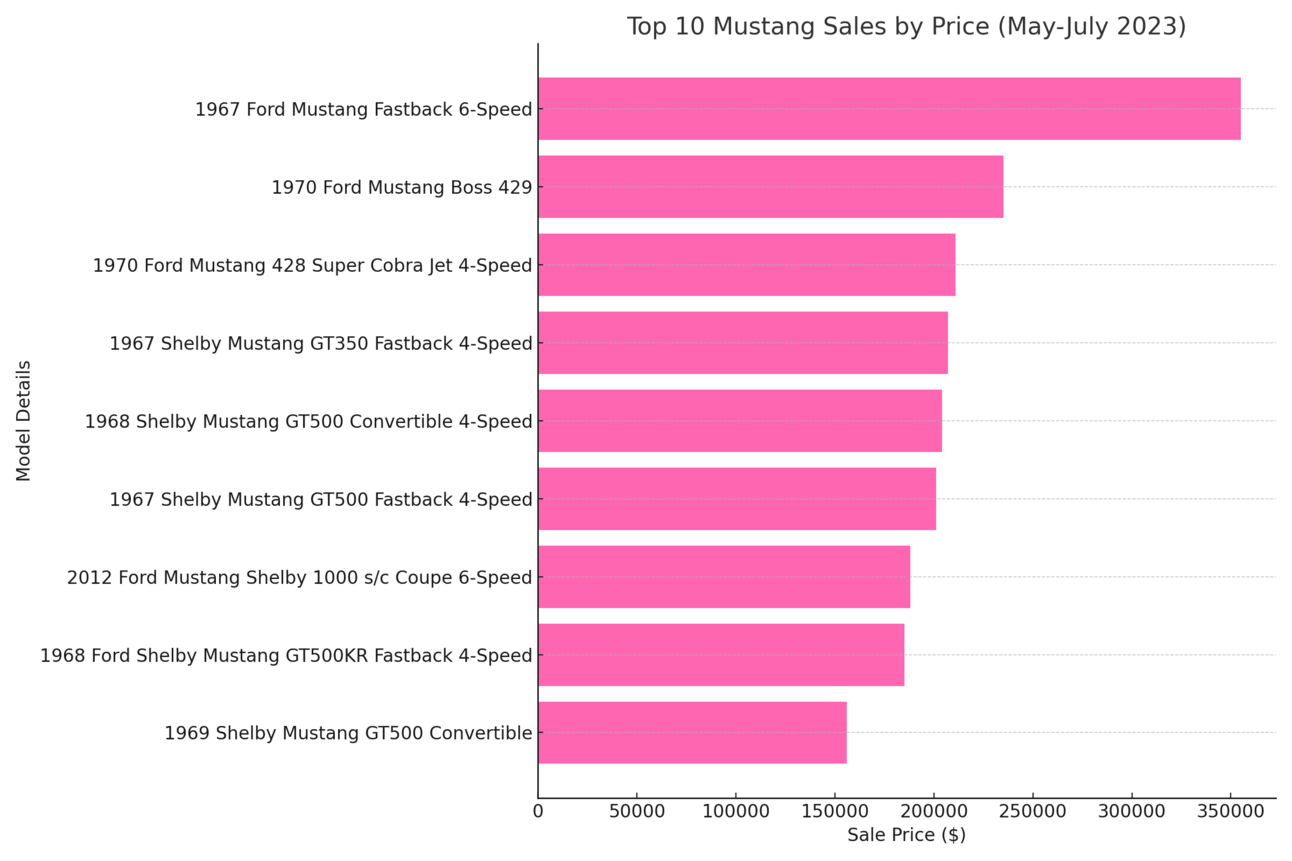
1965 was the most popular model sold in the months of May-July. Fun fact: The 1965 Ford Mustang is where the legend began. Launched in mid-1964, it created the "pony car" class of American muscle cars. Iconic for its long hood and short deck, the '65 Mustang became an instant classic. Its affordability and performance made it a hit with the younger generation, and its impact on car culture is still felt today.

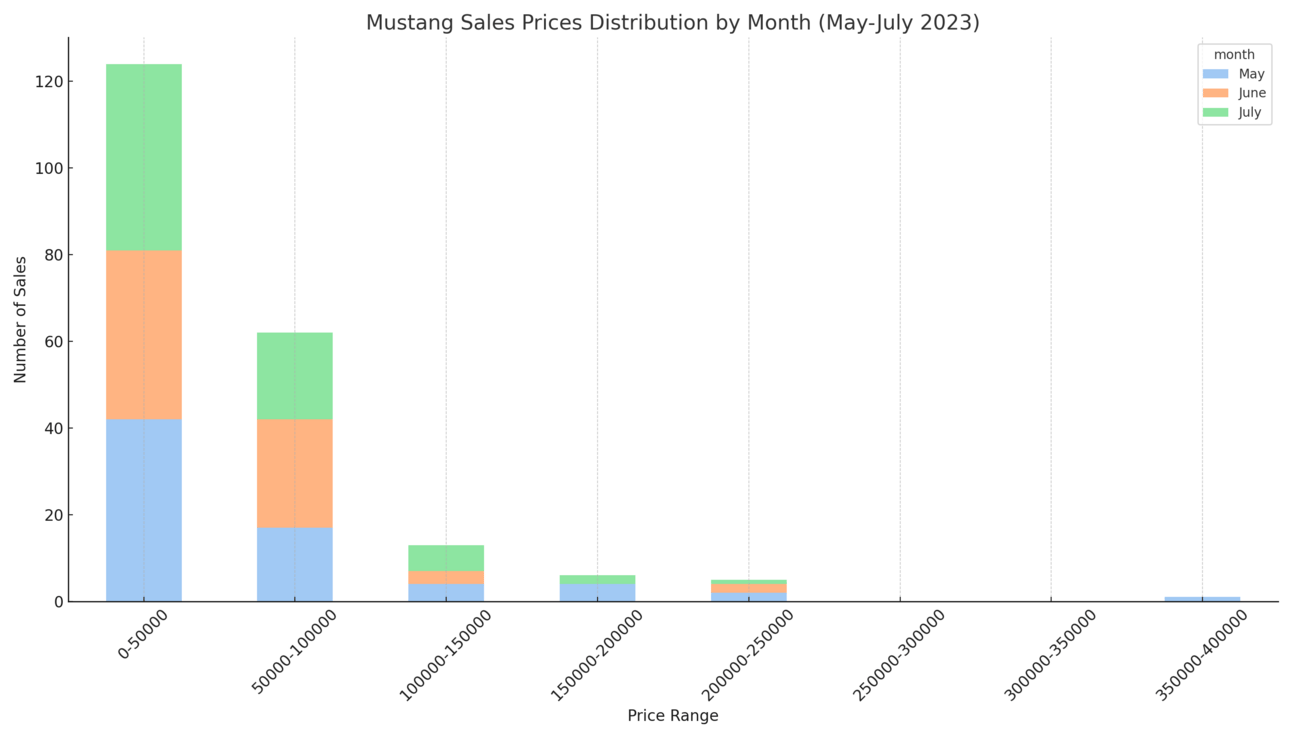
It’s not surprising that there are a number of higher priced sales with Mustangs. If a highly original ‘67 Mustang Fastback came on to the market as with many Mustangs they are highly desirable.
OTHER NOTABLE SALES
Endless Possibilities in Analysis, but Let's Focus on Noteworthy Sales
While the temptation to dissect every make and model may be strong, let's narrow our gaze for now to a few standout sales – both impressive and not-so-stellar. Take, for instance, the case of Tesla: a mere 8 cars found new owners on BaT. Currently, only a solitary Tesla is up for grabs. If you happen to be in possession of one you're keen to sell, or if you're on the hunt for a Tesla, it's worth noting that other avenues might prove more fruitful than Bring a Trailer.
Tesla

Lamborghini
As you can see I’ve excluded the tractor sales as they don’t particularly interest me, although BaT seem to sell 1 or 2 a month.

Ferrari
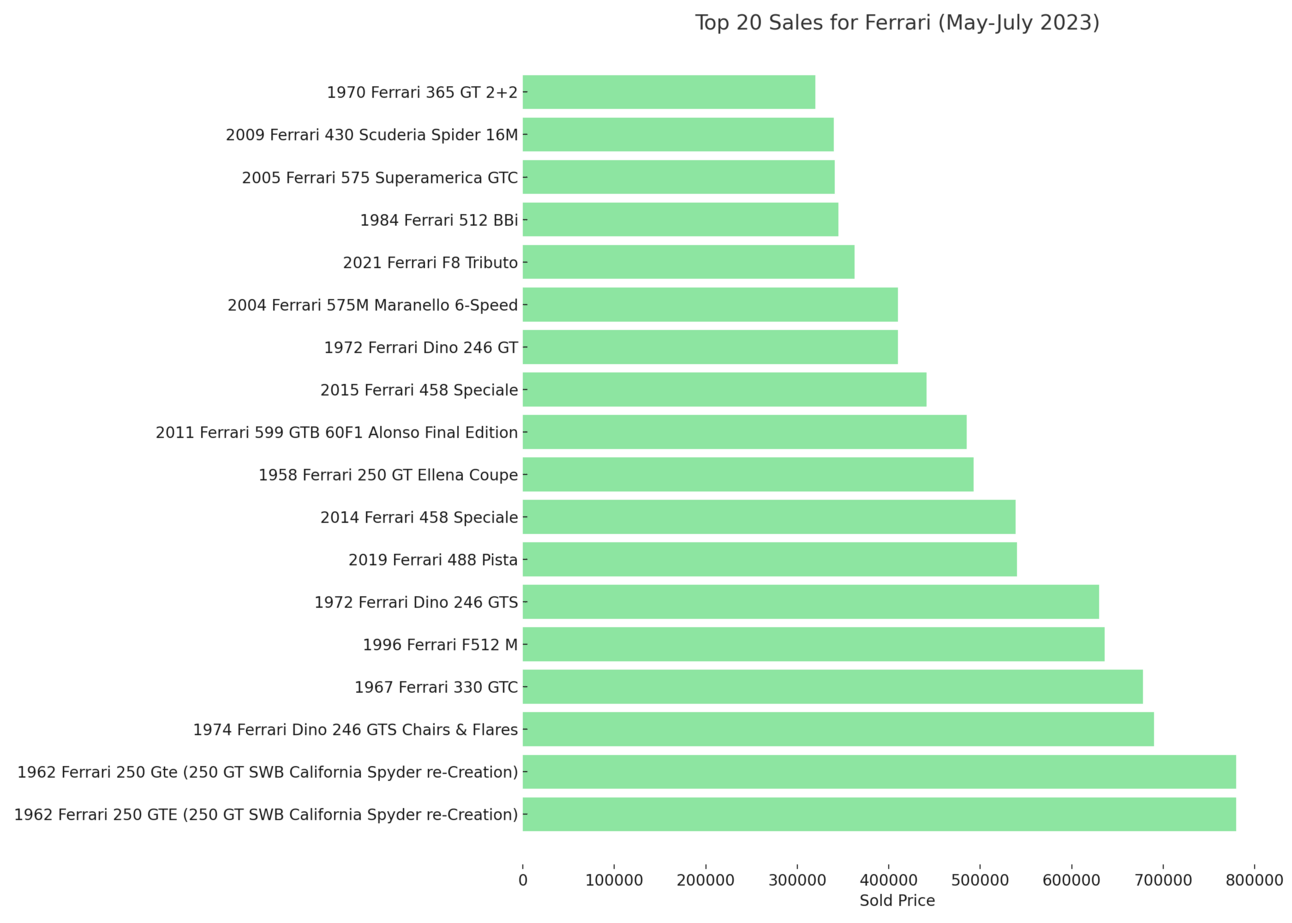
BaT average over 50 Ferrari sales per month. Below I’ve highlighted to the top 20.
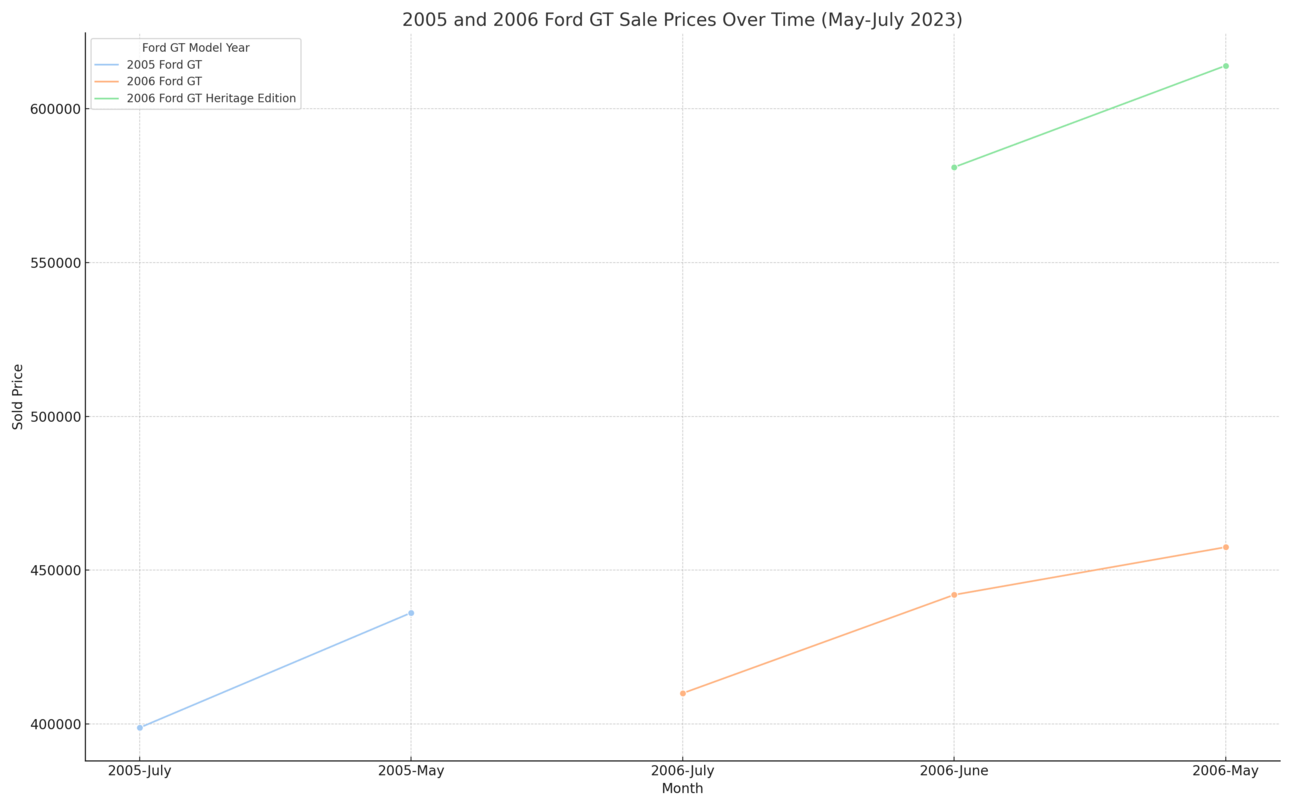
2005 & 2006 Ford GT
Prices across the board for all models of the 2005 & 2006 Ford GT have gone down. Think carefully before listing one for sale right now. IMO prices will at ‘some point’ bounce the other way.
REVENUE
Let’s get into the money. How much does BaT make, it’s the question we all want know including me!!
Bring a Trailer has a standard revenue model that is both simple and effective. For every vehicle listed, they charge a flat fee of $99. This straightforward pricing eliminates any initial hesitation from sellers. However, once a vehicle is sold, BaT takes a 5% commission from the sale price. But this commission isn't open-ended; there's a ceiling and a floor. The maximum commission they'll collect from a sale is capped at $5,000, ensuring high-value vehicle sales aren't overly taxed. Conversely, there's also a floor to ensure profitability; even if 5% of a car's sale price dips below $250, the minimum commission BaT will take is $250.
While the listing and commission fees are their primary revenue streams, it's worth noting that they likely have ancillary revenue channels. For instance, while not explicitly factored into our revenue calculations, BaT encourages upgrades to enhance listings. A significant aspect of these upgrades might revolve around photography. Given the importance of visual appeal in online car auctions, high-quality photos can significantly boost a car's sale prospects. While it might cost BaT between $150 to $250 to commission a professional photographer, they market this service to sellers at $429, ensuring a markup. They also offer a white glove level service for premium cars.
The revenues I have calculated below only take into account the sales of the car, which is the majority of their revenue.
Influence of Lower-Priced Cars on Bring A Trailer's Revenue

Bring A Trailer has always been a diverse marketplace, hosting both premium luxury cars and more affordable classics. The revenue pattern over the last quarter reflects this mix.
May 2023: In May, a significant number of cars priced below $50,000 found new owners. In fact, nearly 1,900 cars were sold under this price point, with almost half of them being under $20,000. These more affordable cars play a crucial role in stabilizing the platform's revenue. While their individual contribution to the buyer's fee might be lower, their sheer volume ensures a consistent revenue inflow, especially from listing fees. I calculated their revenue’s to be at just over $5m for May.
June 2023: June saw a slight reduction in the sales of cars below $50,000. Cars under $20,000 also had a dip. This drop could be attributed to a variety of factors, including seasonal buying patterns or market dynamics. Despite the decrease, the volume of these cars ensures a reliable base for the platform's earnings. Revenue’s went down in June to $4.4m
July 2023: July mirrored June in terms of the number of more affordable cars changing hands. With over 1,600 cars sold below $50,000 and less than 850 below the $20,000 mark, these vehicles continue to form the backbone of the platform's transaction volume. Their influence on the revenue is twofold: a steady contribution from listing fees and a cumulative impact from buyer's fees, even if they might be at the minimum threshold. Revenues went up very slightly in July to $4.5m.
In Conclusion: While high-end luxury vehicles often grab the headlines, it's the more modestly priced cars that form the bulk of transactions on Bring A Trailer. Their consistent presence ensures a stable revenue stream, highlighting the importance of catering to a broad spectrum of car enthusiasts.
As aside note to all the revenue details, I don’t know how many deal fall apart after the auction ends. I imagine a very small percentage don’t happen for one reason or another. BaT always will take the 5% fee after the auction, however people will no doubt chargeback on their cards if the deal doesn’t happen and then it’s a lottery to see if BaT will get that fee back from the card company.
️ Distinctive Strategy: Bring a Trailer's Hands-Off Post-Auction Approach ️
In the labyrinth of auction dynamics, Bring a Trailer defies the norm by adopting a distinctive strategy. Unlike its counterparts, BaT refrains from orchestrating post-auction deals. Instead, they opt to provide a platform where the highest bidder and seller directly interface. In contrast, other auction houses often traverse post-auction negotiations to bolster revenue, even at the cost of a percentage of the final sale price.
❓ Missing Opportunities? A Deliberate Decision ❓
The question arises: why does BaT seemingly relinquish potential post-auction revenue? This pondering is particularly relevant given the platform's solid sell-through rates, fluctuating between 70% and 85%. A case in point is a recent yesterday, where out of 127 listings, 102 cars found new homes, achieving an impressive 80% sell-through rate. Imagine if a fraction of unsold vehicles could transition into post-auction sales. Even securing deals for just 3 unsold cars at the average sale price of $49,000 could mean an additional $7,350 in commission revenue daily.
The Wider Canvas: Long-Term Potential Gains
When this notion is extended over a year of daily auctions, the prospect of extra revenue looms significantly larger. What may appear as a modest $7,350 surplus per day could transform into a staggering $2,682,750 over a year, as they are the only platform to auction vehicles 7 days a week. While this pursuit of potential profits entails extra effort and negotiation for BaT, it beckons us to question why such a strategy hasn't been adopted more fervently.
The Decision's Facets: A Balancing Act
The choice to stand aloof post-auction isn't merely tethered to revenue concerns. Conversations with sellers on the platform highlight that many would appreciate BaT's intervention, as they've witnessed deals collapsing all too easily. The conception that individuals might wait until after the auction to clinch a "deal" could be a misperception. In reality, people continue to bid actively and covet the distinction of being the highest bidder. Adapting this strategy while managing their considerable auction volume in my opinion is very feasible, with the auction manager who ‘owns’ the listing that could take care of the after-deals. The question is do they want the hassle in dealing with this? But they already get enough interaction with sellers after the auction who don’t sell, with no doubt some complaining etc.. why not just turn that into a positive and help negotiate a sale and take some extra revenue?
Navigating Listing Times and Approvals:
Listing your vehicle on Bring a Trailer involves a multi-faceted journey, occasionally painted with nuances that draw both praise and criticism from sellers. The process begins when hopeful car owners submit their cherished rides, dreaming of the auction stage. However, it's no secret that BaT's stringent selection criteria sometimes lead to disappointment, leaving some potential sellers disheartened. While the platform has its prerogative to curate its offerings, the lack of explicit reasons for rejections can be perplexing, particularly when enthusiasts passionately believe in the uniqueness of their vehicles.
♂️ The Art of Persuasion: BaT's Approach to Reserves and No Reserves ♂️
When you're on the cusp of listing your vehicle and don't possess a dealership or existing connections, you'll likely encounter BaT's intriguing strategy. They often encourage the "no reserve" approach, particularly for lower-end cars. However, if you choose a reserve, be prepared for some negotiation nudges. BaT's robust influx of listing requests gives them a significant upper hand in such interactions. These interactions, combined with persistent pushes for additional photography and price adjustments, can sometimes leave sellers with mixed feelings. While this tactic might not resonate with everyone, it's evident that BaT's methods have contributed to their undeniable success.
Shedding Light on the Listing Process
Once you've navigated the persuasion dance and submitted over 100 photos and videos, BaT's team takes the reins. They craft a compelling narrative about your vehicle, weaving its story for prospective bidders. After this stage, you're informed about your listing's readiness for approval. The approval itself is the green light for your car's journey onto the auction stage. Timeliness is key at this juncture, as once you approve, your vehicle can go live swiftly. The timing of this approval is strategic, allowing you to align the auction's conclusion with your desired timeframe.
⏱️ From Submission to Live: The Timing Tangle ⏱️
The journey's duration is intertwined with the thoroughness of your submission. Any delays, like the involvement of a photographer, could prolong the process. Feedback from many sellers indicates that recent enhancements have expedited listings, bringing the duration down to approximately 15 days for some. Yet, experiences vary, with some waiting weeks for their listings to go live. This discrepancy signals ongoing backend improvements to streamline the submission-to-live process and cater to the wide spectrum of seller experiences.
MY TAKE ON THE FUTURE
In this dynamic realm, where satisfaction takes on its own melody, BaT's approach elicits a spectrum of emotions, painting a vibrant canvas that shapes an automotive auction haven. The synergy between their methods and the ever-shifting landscape of seller expectations orchestrates a captivating symphony, sculpting a distinctive space within the bustling marketplace.
From my vantage point, they aren't just a name; they're an orchestra of accomplishments. Their journey, embarking in 2007, and enriched by their pivotal sale to Hearst in 2020, paved the way for a trajectory that's as audacious as it is innovative. While 2023 might have presented some hiccups in their growth – as we all know, bumps are part of every adventure – they remain steadfast in steering the ship towards uncharted horizons. BaT isn't one to tread the trodden path. They could've easily joined the pack, embracing 200+ daily listings and even a 'Buy It Now' corner. But that's not their rhythm. Their rhythm is defined by innovation, by embracing the road less traveled, and that's what truly sets them apart.
Let's face it – the pursuit of perfection is an unending journey. But here's what's crystal clear: BaT has their compass pointed true north. Sure, there's room for improvement – hey, I've got a knapsack filled with ideas – but such is the path of trailblazers. Fact is, they've galloped ahead of the pack, a market leader by miles. While others play catch-up, BaT is dancing to its own rhythm, recalibrating sell-through rates, amplifying average sale prices, enhancing customer service – all while keeping a sharp eye on their bottom line.
As I wrap up, another thought crosses my mind – the "threat" posed by physical auction houses. Right now, events like Monterey car week are unfolding, and it's a bit of a bummer that I couldn't make it this time around ☹️. Undoubtedly, there will be some jaw-dropping sales taking place. However, the fees they charge are more than double what online auction houses demand. A few are testing the waters with a hybrid model that combines the best of both worlds, but I'm skeptical about its viability.
The takeaway? It's crystal clear that you can successfully auction a $5 million beauty online, and I'm willing to bet that in the future, a $10 million or even higher-priced gem could find its new home on BaT or another digital auction platform. The future belongs to the online realm, and with a little more tech magic (I've got a stockpile of ideas), the market could—and probably will—expand even further. And don't get me wrong, physical auction houses will still have their place. But it's no surprise to see many of them casting their gaze towards the online space, pondering how to hop on board.
And now, let's wrap up the curtain call, shall we? BaT isn't just a market dominator; they're a revolution. Their choices, their principles, and their indomitable spirit have forged an auction platform that's not just about cars; it's about passion, camaraderie, and the art of sharing the automotive dream.
I can’t provide all these insights and trends without showcasing the most popular days of the week to sell a car So here you have it, with Wednesday a very slight favorite.
